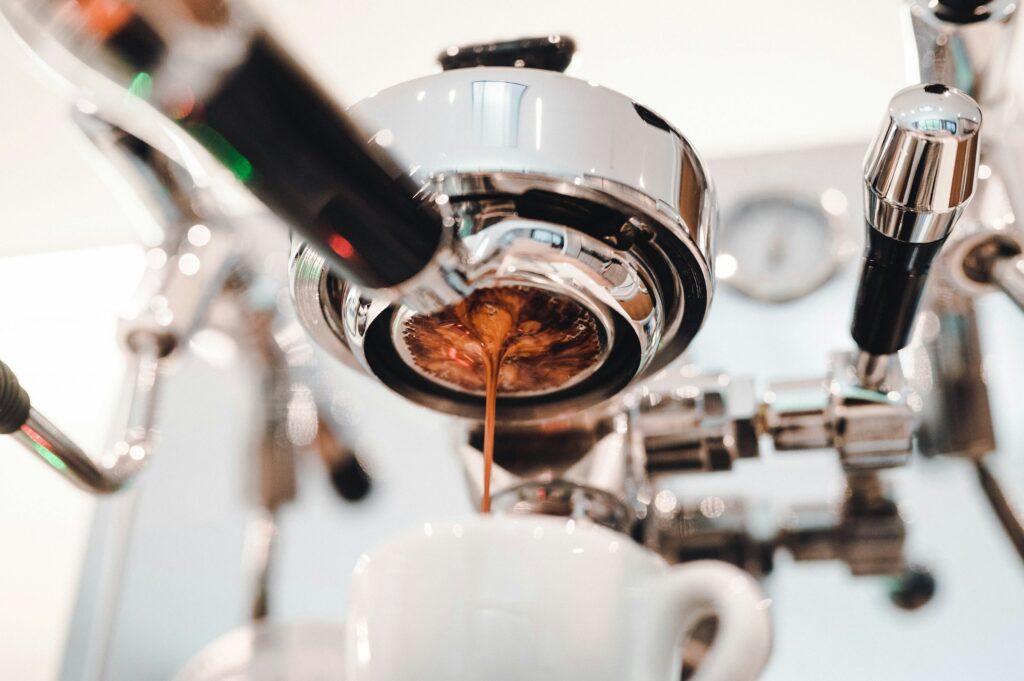
Want great espresso without spending a fortune? You can get a solid home espresso maker for around $300 or less.
We’ve rounded up five top picks that cover manual lever machines, semi-automatic brewers, and even capsule/automatic units.
Each choice delivers good flavor and features on a budget.
Below, we explain what makes each one special, with quick pros and cons to help you decide.
5 Best Budget Espresso Machines: At A Glance
- Breville Bambino – Best Starter Semi-Auto Espresso Maker
- Flair PRO 2 – Best Manual Lever Espresso Maker
- De’Longhi Dedica – Best Slim Semi-Automatic Espresso Machine
- Nespresso Essenza Mini – Best Capsule Espresso Machine
- Mr. Coffee One-Touch CoffeeHouse+ – Best Automatic Espresso/Cappuccino Maker
1. Breville Bambino – Best Starter Semi-Auto Espresso Maker
The Breville Bambino is a favorite entry-level machine. It heats up fast with a powerful 15-bar pump and PID temperature control, so you can pull a shot in about 3 seconds.
Reviewers praise it for being “easy to use” with a “quick warm-up.” At under $300 (around $280 on sale), it’s a great value.
Pros
Compact footprint; fast heat-up (thermojet heater); steady temperature control and volumetric dosing; includes quality tamper and filter baskets.
Users note it’s very “easy to use” with quick start-up.
Cons
No automatic frothing – you must manually froth milk. No 3-way valve means you may get a little pump “sneeze” when pulling shots.
The drip tray is also on the small side, so you may need to empty it frequently.
2. Flair PRO 2 – Best Manual Lever Espresso Maker
Coffee purists love the Flair PRO 2. It’s an all-mechanical, hand-lever machine (no electricity for brewing) that delivers café-quality shots when used carefully.
Impressively, it mimics features of $3,500 machines – most notably a real pressure gauge for pressure profiling, and a solid stainless steel brew head.
In other words, you control the pressure by hand and get feedback on the gauge. It’s portable and durable too (the whole kit packs in a travel case).
Pros
Incredible shot control for the price – real pressure gauge and lever let you dial in professional shots. Solid metal construction retains heat well.
No electronics means less to break and you can take it anywhere.
Cons
Manual only – there’s no pump, and it cannot steam or froth milk. You have to preheat every part by hand (group, cups, etc.) before each shot.
This isn’t a plug-and-play machine, so beginners need practice. It’s also slightly above $300 (about $325), though many consider the extra control worth it.
3. De’Longhi Dedica – Best Slim Semi-Automatic Espresso Machine
If you have limited counter space, the De’Longhi Dedica is a super-thin semi-automatic machine (about 6″ wide) that still offers full espresso bar features.
It’s well reviewed for packing a “good result in the cup” at a low price. The Dedica pulls 15-bar shots and has a manual steam wand for lattes and cappuccinos.
It also offers programmable volumetric shots (you can set how many ounces to dispense), which is rare at this price.
Pros
Very compact design with a fast heat-up time. Delivers consistently decent espresso for the price.
Includes a manual frother wand so you can steam milk. Users appreciate its slim footprint and low cost.
Cons
The narrow drip tray limits cup height, and the water tank is small. Build quality is mostly plastic (though trims are metal) so it doesn’t feel as heavy-duty as more expensive machines.
Volume dosing helps, but you may need to run a couple of “empty shots” beforehand to fully heat the group (a quirk of its small thermoblock heater).
4. Nespresso Essenza Mini – Best Capsule Espresso Machine
The Nespresso Essenza Mini is a tiny capsule brewer that makes 19-bar espresso or lungo shots at the touch of a button. Users rave that it’s “small and slim” yet produces “great espresso.”
It heats up in under 30 seconds and has only two brew buttons (espresso or lungo), so operation is simple. The price is very affordable (around $180–$190), making it a solid budget choice.
Pros
Extremely compact and easy to use. Heats up very fast and pulls consistent shots with Nespresso pods.
Users note its “compact size” and portability – it fits anywhere. It also has an automatic shut-off for energy saving.
Cons
It only uses Nespresso’s proprietary capsules, so your coffee options and cost per cup are limited.
There’s no milk frother (Nespresso sells a separate Aeroccino); you must manually steam milk or use cold foam.
Cup sizes are fixed by the machine (no way to fine-tune volume on the fly), and the fixed water tank holds only about 20 oz.
5. Mr. Coffee One-Touch CoffeeHouse+ – Best Automatic Espresso/Cappuccino Maker
The Mr. Coffee CoffeeHouse+ is a super-automatic style brewer that does espresso, cappuccinos, and lattes at one touch.
It has a built-in milk reservoir and automatic frother, so it can make milk drinks without you holding a steam wand.
The one-touch control panel has buttons for single or double shots and froth level.
For a budget of around $200, it’s a versatile pick with convenience features.
Pros
One-touch operation – just press a button for espresso, cappuccino or latte. Built-in automatic milk frother and a large (18 oz) milk reservoir (removable for cleaning) make creamy drinks easy.
The progress bar indicator is handy to show the brewing status. It even accepts ESE espresso pods in addition to ground coffee, which can simplify dosing.
Cons
It’s larger in size and mostly plastic construction, so it doesn’t feel as high-end. It still requires regular cleaning and descaling.
The shots aren’t quite as refined as a good semi-auto machine (more like a thick coffee).
Also, because the milk frother is automatic, it can be a bit noisy and takes a few extra seconds to prep.
Budget Espresso Machine Buyer’s Guide
1) Start with your goal and budget
Decide what you actually drink most. Straight espresso? Milk drinks daily? Occasional cappuccino on weekends? Your drinks drive your needs. Then set a hard ceiling for spending.
Remember, the machine isn’t the only cost. You’ll likely need a grinder, milk jug, scale, and cleaning supplies. Budget for the whole kit, not just the shiny box.
2) Pick your machine type first
Manual lever: quiet, ritual-heavy, huge control. But you do everything by hand.
Semi-automatic: you grind, tamp, and start/stop shots. Best skill-builder.
Fully automatic/super-auto: push a button, get coffee. Fast and clean, less craft.
Capsule/pod: lowest effort and mess. The highest cost per cup and limited flexibility.
Choose the workflow you’ll actually enjoy at 7 a.m., not the one you admire on YouTube.
3) Heating system matters
You’ll see thermoblock, thermocoil, and single boiler.
Thermoblocks/thermocoils heat fast and keep prices low. Good for small kitchens and quick shots.
Single boilers hold heat better but warm up slower and can lag when switching from brewing to steaming. If you love lattes, favor machines that recover heat quickly.
4) Pressure: ignore the marketing, check the reality
Boxes shout “15–20 bars.” Espresso wants ~9 bars at the puck. The headline number is pump capability, not what your coffee sees. Look for stable, repeatable extractions, not the biggest number on the sticker.
5) Temperature stability & control
Hotter isn’t better. Consistency is king. A PID controller keeps water within a tight band, which means a steadier flavor. Thermostats work but swing more. If your budget allows, PID is a lovely upgrade for predictable shots.
6) Portafilter size and baskets
58 mm is the café standard: lots of basket and accessory options. 54/51 mm can work well, but you’ll have fewer aftermarket tools. Pressurized baskets forgive imperfect grinds and pre-ground coffee.
Non-pressurized baskets demand a good grind and technique, but reward you with better crema and flavor. Beginners often start pressurized, then switch later.
7) Grinder: the unglamorous MVP
A modest machine with a decent burr grinder beats a fancy machine with a poor grinder. Fresh, uniform grounds decide flavor, flow, and crema.
If money is tight, allocate more to the grinder than you think. It’s the steering wheel of your espresso.
8) Milk steaming power and wand design
Love lattes? You need steam muscle. Small thermoblocks can steam, but slowly. A good wand gives dry steam and microfoam without waiting forever.
Panarello tips make frothing easy but limit finesse. Bare wands have a learning curve but produce silky milk for latte art. If milk drinks are consumed daily, prioritize steam performance.
9) Pre-infusion, shot timing, and volumetrics
Pre-infusion wets the puck gently to reduce channeling. Helpful on budget gear.
Volumetric dosing lets you program single/double volumes for repeatability.
A shot timer (built-in or on your phone) keeps you honest. Data beats vibes when dialing in.
10) Build quality, materials, and ergonomics
Metal frames feel solid and dampen vibration. Plastics keep cost and weight down. Neither is evil; execution matters.
Check the feel of the portafilter lock-in, the sturdiness of the steam knob, and how easy it is to clean around the group. If the drip tray is tiny, you’ll empty it constantly. That gets old fast.
11) Water tank, footprint, and noise
Small tanks mean more refills. Big tanks hog counter space. Measure your spot and the cabinet above it. Some machines are loud by design (vibratory pumps).
If you live with light sleepers, put noise on your checklist.
12) Maintenance: the not-so-fun but crucial part
Espresso machines need love. Backflushing, descaling, and wand purging keep shots tasty and parts alive.
Check how filters change, how the drip tray removes, and whether you can access the shower screen with a screwdriver. If cleaning is a pain, you won’t do it. Your taste buds will notice.
13) Water quality = flavor quality
Bad water ruins good coffee and machines. Use filtered, low-scale water. Avoid distilled water unless the manufacturer instructs remineralization.
Taste your water before you ask it to make your espresso taste good.
14) Controls and learning curve
Buttons and icons are great. Clear feedback is better. Can you see when it’s ready to brew? Does it signal when it’s steaming? Are the lights and beeps understandable without a manual?
You want a machine that helps you succeed, not one that speaks in riddles.
15) Safety and puck dryness
A three-way solenoid valve vents pressure after the shot and leaves a drier puck. Many budget machines skip it.
Wet pucks aren’t a crime, but dry pucks are cleaner and nicer to knock out. Not a deal-breaker, just a perk.
16) Included accessories (they add up)
A sturdy tamper, a milk jug, dual baskets, and a cleaning kit can save you money. Flimsy plastic tampers are common at this price. Plan to upgrade. A scale with a timer is worth its weight in crema.
17) Warranty, parts, and support
Read the warranty length and what it covers. Scan for easy-to-order parts: gaskets, baskets, and steam tips. A responsive support email beats a pretty brochure when something squeaks.
18) Upgrades and future-proofing
Think two steps ahead. Can you later switch to non-pressurized baskets? Swap a steam tip? Add a bottomless portafilter?
If the espresso bug bites, small upgrades keep you happy without buying a new machine.
19) Refurbished and used options
Refurbished items from reputable sellers can stretch your budget. Used can be a steal or a headache. Look for proof of descaling and basic maintenance.
If it “just needs a gasket,” assume it needs more than a gasket.
20) Total cost of ownership
Pods cost more per shot but save time. Whole beans are cheaper but need a grinder. Add water filters, cleaning tablets, descaler, and occasional gaskets to the math. Cheap to buy, can be pricey to keep.
Quick “Who Should Buy What?” guide
- Mostly straight espresso, enjoy tinkering: Semi-auto + good burr grinder.
- Daily milk drinks, minimal fuss: Semi-auto with strong steam or an entry super-auto.
- Zero mess, tiny space: Capsule machine, plus a standalone frother if you like milk.
- Ritual lover, traveler, or power cuts: Manual lever with a kettle and a solid grinder.
Five-minute in-store (or unboxing) test
- Lock in the portafilter. Does it feel solid or crunchy?
- Run water and steam back-to-back. How fast does it recover?
- Check noise. Could you live with that every morning?
- Inspect the drip tray and tank. Easy on/easy off?
- Time a shot of water through the basket. Is the flow steady, not sputtery?
Red flags on a budget machine
- Wild temperature swings or “it’ll warm up eventually” vibes.
- Steam that hisses but barely textures milk.
- Only a pressurized basket is included, with no option to upgrade.
- No basic cleaning access to the group/shower screen.
- A warranty that has more loopholes than coverage.
Handy pre-purchase checklist
- Machine type matches my drinks and patience
- The heating system recovers fast enough for milk drinks
- PID or stable temps (nice-to-have, not required)
- Portafilter size and basket options I want
- Grinder plan sorted (now or soon)
- The steam wand can texture microfoam
- Easy cleaning access + available parts
- Fits my space, power, and noise tolerance
- Warranty, I can live with
- Total ongoing costs make sense

Hi, I’m Selene Veyra! I’m the coffee-loving creator of Brewed Moments. My passion for coffee began in my grandmother’s kitchen, where her morning brew sparked a lifelong love for the beverage. Now I test brewing methods, gear, and homemade café-style recipes to make great coffee simple for everyone ☕


